Model selection and benchmarking
We test the realistic candidates against your actual tasks and score them on accuracy, latency, and cost, so the choice is made on evidence rather than on whatever is trending.
LLM Integration
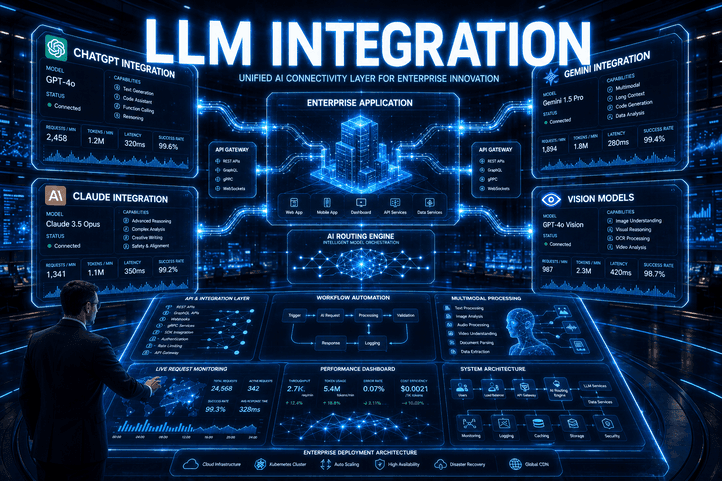
We take the software and workflows you already run and add intelligence where it changes the outcome. Model selection, prompt architecture, evaluation, cost control, and a deployment that holds up under real traffic.
Why It Matters
Anyone can wire a language model into a feature over a weekend. The gap between that prototype and something you can put in front of paying customers is where most projects stall. Output that varies between runs, prompts nobody dares touch, latency spikes at peak hours, and a bill that grows faster than usage.
We build the layer that makes it dependable. Structured outputs your code can trust, retries and fallbacks when a provider degrades, caching and routing that send cheap requests to cheap models, and an evaluation suite that tells you whether last night's prompt change made things better or worse.
We also keep you free to move. Providers change pricing, release better models, and deprecate old ones on their own schedule. Our integrations sit behind an abstraction so swapping the model underneath is a configuration decision instead of a rewrite.
Capabilities
The unglamorous engineering that turns a promising demo into a feature your customers rely on.
We test the realistic candidates against your actual tasks and score them on accuracy, latency, and cost, so the choice is made on evidence rather than on whatever is trending.
Versioned prompts, structured schemas, dynamic context assembly, and few shot examples drawn from your own data, all kept in code and reviewable like any other logic.
Summarisation, extraction, classification, drafting, translation, and search built into your existing product surfaces, with streaming responses and graceful failure states.
Semantic caching, model routing by task difficulty, batching, prompt compression, and hard spend limits with alerts, so the finance conversation stays boring.
Regression suites over golden examples, automated scoring, live tracing of every request, and dashboards for quality, spend, and latency across every feature.
Open weight models running in your own environment, fine tuned where it earns its cost, for teams whose data genuinely cannot leave the building.
How We Work
No six month discovery phase. We move in short cycles and you see working software early.
We review your product and workflows and pick the places where a language model measurably improves the outcome, then rule out the places where plain software is simply better.
We build the smallest honest version, run it against real examples on several models, and put accuracy, latency, and cost per request in front of you before committing.
Structured outputs, validation, retries, fallbacks, rate limiting, caching, and observability go in, along with the evaluation suite that protects future changes.
The feature ships behind flags into your existing codebase and design system, released to a slice of traffic first so you see real behaviour before everyone sees it.
We watch quality, spend, and adoption after launch, tighten prompts, and move traffic to cheaper or stronger models as the landscape shifts underneath us.
Tools we build with
Share the feature you have in mind or the prototype that stalled. You will get a straight technical opinion, a scope, and a cost estimate you can plan around.
We reply within 24 hours with a clear plan, a timeline, and a number.
Use Cases
Patterns we have shipped before, so we already know where the traps are.
Natural language search across your product data plus summaries that save users from reading long records, threads, or reports every single time.
Turn invoices, forms, emails, and reports into clean structured records your systems can act on, with confidence scores and review queues for the uncertain ones.
First drafts of replies, proposals, listings, and product copy generated in your tone of voice, with a human keeping final say before anything is published.
Tickets, leads, transactions, and documents sorted and routed automatically with reasoning attached, replacing brittle keyword rules that break every quarter.
Let your team ask questions of their own data and get charts and answers back without waiting on an analyst or learning a query language.
An assistant inside your application that explains, guides, and performs actions for users, driving activation and cutting the support load that follows confusion.
What You Get
You finish the engagement owning the system, the code, and the knowledge to run it without us. That is the point.
FAQ
The questions every serious buyer asks us before the first invoice.
Yes, that is the normal case. We work in your repositories, follow your conventions and review process, and ship through your pipeline. Most of our integration work is additive rather than a rewrite.
Structured output schemas with validation, retries on malformed responses, deterministic settings where they help, and an evaluation suite that runs against golden examples on every change. Anything that fails validation never reaches your user.
Semantic caching for repeated work, routing simple tasks to smaller models, trimming context aggressively, and batching where latency allows. We instrument cost per request from day one and set hard spend limits with alerts.
You switch. The provider sits behind an abstraction with an eval suite in front of it, so trying a new model is a configuration change and a benchmark run rather than an engineering project.
Only when it clearly beats the alternatives. Better prompting, retrieval, and routing solve most problems faster and cheaper. When fine tuning genuinely wins, we handle the dataset, the training, and the evaluation.
No. We use enterprise endpoints with training disabled, and for sensitive workloads we run open weight models entirely inside your infrastructure.
Keep Exploring
Most of our work combines two or three of these. Start where the pain is loudest.
Tell us the problem in plain language. We will tell you whether it is worth building, what it takes, and what it costs, before you spend a rupee or a dollar.
We reply within 24 hours with a clear plan, a timeline, and a number.