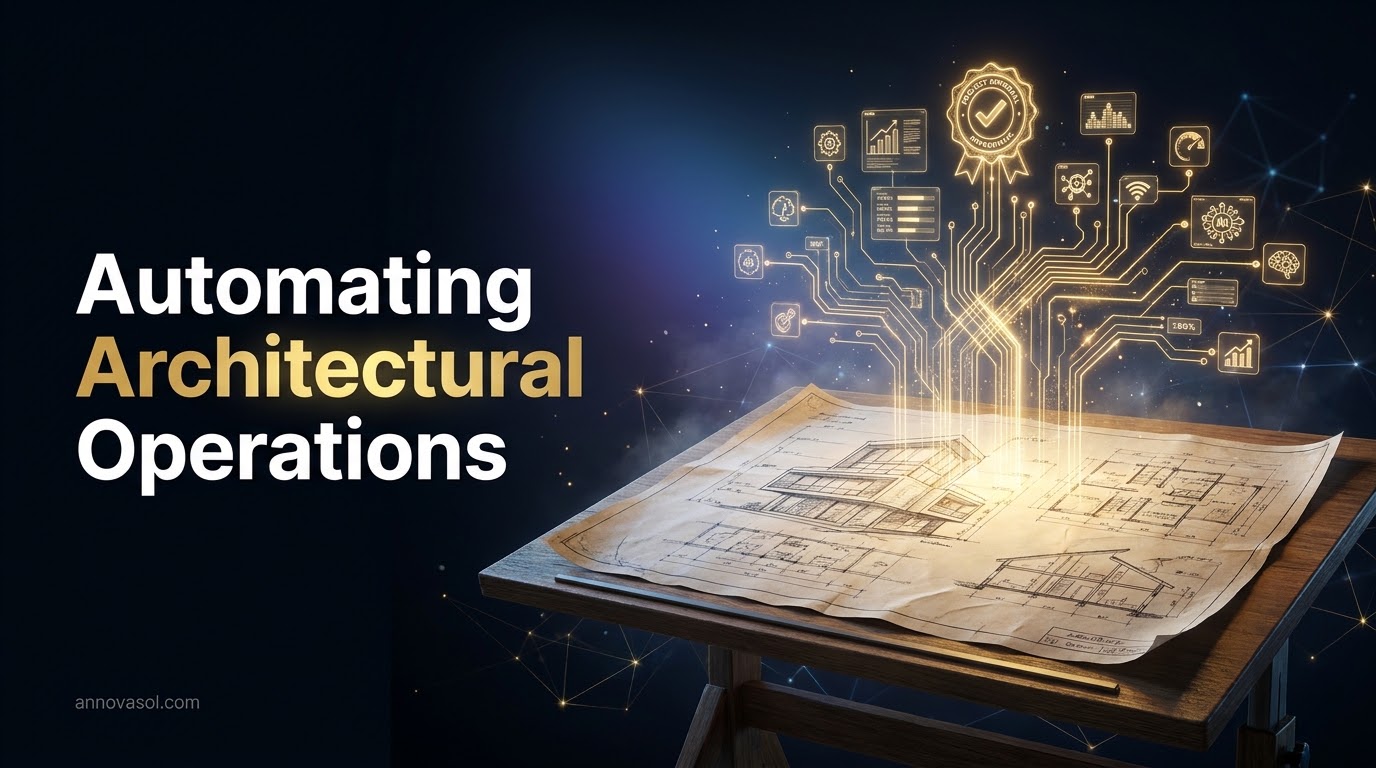
AI workflow automationarchitecture practice managementDeltek Ajera integrationconstruction administration
AI Workflow Automation for Architecture Firms: 2026 Guide
Learn how ai workflow automation for architecture firms cuts non billable CA overhead, automates Deltek Ajera tracking, and scales firm billable capacity.
At least 34 percent of practicing architects already use intelligent software agents to accelerate complex building code compliance audits, according to research published by Gitnux. Yet across the broader industry, most firm partners continue to treat artificial intelligence as little more than an image generator for conceptual client decks. That narrow perspective creates a costly blind spot. While generative design tools capture headlines, implementing end to end ai workflow automation for architecture firms addresses the true threat to practice profitability: administrative friction, unbilled construction administration hours, and disconnected enterprise databases.
Design practices operate on narrow margins where profitability hinges entirely on employee utilization rates. When licensed project architects spend twelve hours each week hunting down submittal discrepancies, formatting field observation memos, or manually keying time data across disparate databases, your firm loses direct billable capacity. Scaling administrative headcount is no longer the answer. Forward thinking managing principals are turning to structured operational agents to reclaim lost revenue, accelerate project delivery, and eliminate manual document workflows.
What Is AI Workflow Automation for Architecture Firms? (Beyond Rendering & Midjourney)
Most architectural discussions surrounding artificial intelligence center on diffusion image generators like Midjourney, rendering tools like Chaos Enscape, or early stage massing algorithms like Autodesk Forma. While Gitnux reports that generative design tools reduce early design iteration time by 73 percent, generative imaging does not resolve the operational quagmire of professional practice. Rendering represents less than 15 percent of an architecture firm's contracted phase workload, whereas production documentation, coordination, and project delivery consume the vast majority of fee allocations.
Operational workflow automation operates at the intersection of large language models, retrieval augmented generation systems, optical character recognition engines, and enterprise resource planning software. Instead of generating speculative concept art, operational automation structures unstructured information. It extracts project data from contractor product data sheets, cross references specifications against master CSI MasterFormat databases, tracks drawing revisions against structural engineering sets, and synchronizes project milestone billing directly with back office financial systems.
Modern architectural automation operates through autonomous task pipelines that perform cognitive heavy lifting while leaving ultimate design discretion and professional judgment to licensed practitioners. Similar operational transformations have already taken root across adjacent disciplines, as detailed in our guide to AI workflow automation for construction companies. In architecture, intelligent pipelines monitor project inboxes, extract parameters from complex shop drawing schedules, verify dimension tolerances against building codes, and prepare review logs before a project manager ever opens a PDF viewer.
The Core Non-Billable Bottlenecks: Administrative Overhead, Submittals, and RFIs
Every design partner recognizes the gap between target utilization and actual billable performance. Research from Monograph indicates that architecture practices target an average chargeability rate of 77.5 to 82 percent for design personnel, yet actual realized billing often slips well below 65 percent due to non billable operational friction. This friction concentrates heavily within Construction Administration and internal project tracking.
Consider the Request for Information workflow. According to research published by Procore, reviewing and responding to a single construction RFI costs an average of $1,080 across all project stakeholders, with cumulative project costs reaching hundreds of thousands of dollars. More than 13 percent of incoming RFIs request clarifications that are already clearly articulated within the primary contract drawings or project manual. An architect must pause active production work, pull up the project specifications, verify previous addenda, draft an explanatory response, log the interaction into an administrative tracker, and distribute the response through contract channels.
Construction submittals present an even larger operational sinkhole. Analysis by BuildSync notes that project teams routinely spend 4 to 8 hours manually reviewing an individual submittal package against complex technical specifications. On an institutional or commercial project involving over 400 distinct submittals, manual reviews consume thousands of unbilled hours, compressing firm profitability.
The most damaging non billable bottlenecks include:
- Manual comparison of hundred page product cut sheets against Division 08 door hardware or Division 09 finish schedules.
- Repetitive data entry required to sync change orders, consultant progress updates, and timesheet logs into firm accounting systems.
- Cross referencing local municipal zoning bylaws, accessibility guidelines, and International Building Code amendments against schematic floor plates.
- Drafting repetitive meeting minutes, site observation reports, and field review certificates from voice recordings or handwritten site notes.
How Architecture AI Automates Project Submittals and Construction Administration
Understanding how architecture ai automates project submittals requires looking at retrieval augmented generation paired with visual document models. In a manual review, an architect receives a 60 page mechanical equipment submittal from the general contractor, opens the 800 page project manual to Section 23 00 00, locates the scheduled performance criteria, and manually checks each line item: air volume ratings, electrical requirements, seismic bracing certifications, and warranty provisions.
Intelligent submittal workflows automate this manual comparison through structured extraction pipelines:
- Ingestion and Parsing: The incoming PDF submittal package is parsed using high fidelity document intelligence models that separate diagrams, tabular schedules, test certificates, and manufacturer product cut sheets.
- Contextual Spec Mapping: The automation pipeline indexes the firm's approved technical specifications, project addenda, and drawing callouts into a vector database.
- Algorithmic Verification: The system performs automated parameter comparisons. It flags whether the contractor's proposed pump motor matches the exact horsepower, voltage, and efficiency rating mandated in paragraph 2.03 of the technical specifications.
- Discrepancy Highlighting: Instead of forcing an architect to read 60 pages, the workflow generates a side by side exception ledger. Any deviation, such as an unapproved finish variation or a missing performance certification, is highlighted alongside direct citations to the relevant contract drawings.
- Review Stamp Generation: The system prepares a draft review response with standardized action markings such as No Exceptions Taken, Make Corrections Noted, or Revise and Resubmit, complete with prefilled comments ready for the architect of record to review, adjust, and sign.
As noted in an analysis by Trunk Tools, automated document comparison reduces manual submittal processing time from more than two hours down to approximately ten minutes per review package, preventing schedule delays while protecting document accuracy.
The same architecture handles RFI triaging. When an incoming RFI arrives, the agent analyzes the question text, parses the indexed project manual and CAD or BIM sheet index, and drafts an initial clarification memorandum that cites the exact drawing sheet number and detail callout where the answer exists. If the question reveals a true scope conflict, the system drafts a preliminary Architect's Supplemental Instructions document for the project architect's review.
Integrating AI Automation with Deltek Ajera and Enterprise ERP Systems
Administrative friction within design firms extends deep into project accounting. Practices commonly manage operations using industry specific enterprise resource platforms such as Deltek Ajera or Deltek Vantagepoint. While Deltek is exceptional for financial accounting, tracking work in progress, and managing labor distribution, project personnel spend excessive non billable hours feeding data into it.
Achieving scalable architecture ai automation with deltek ajera unlocks immense operational value by bridging the gap between project communication and billing administration. In most practices, project managers maintain external spreadsheets to monitor project phases, milestone percentages, and consultant subconsultant invoices because entering data directly into Ajera requires navigating complex accounting submenus.
Modern intelligent automation integrates directly with Deltek via REST APIs and automated middleware webhooks:
- Automated Timesheet and Labor Allocation: Language agents parse calendar appointments, drawing commit histories, and field review logs to suggest accurate phase level time allocations for architects. This dramatically reduces end of month administrative chasing while ensuring accurate direct personnel expense reporting.
- Progress Billing and Phase Completion Sync: When project milestones are reached in your project management or BIM coordination tools, the automation pipeline automatically updates the reported percent complete in the Ajera project command center, generating draft client progress invoices without manual intervention.
- Subconsultant Invoice Reconciliation: When engineering consultants submit structural, mechanical, or electrical fee invoices via email, an AI agent extracts the billed amounts, compares them against the contracted consultant fee caps in Ajera, checks for duplicate invoice numbers, and routes the document for partner approval.
- Real Time Budget Burn Alerts: The automation monitors actual direct labor hours logged against the initial project budget. If a schematic design phase reaches 80 percent of its fee budget while submittals and revisions indicate outstanding design deliverables, the system alerts the managing partner long before project write offs occur.
Firms seeking broader operational improvements can explore how similar integrations function across professional services in our overview of AI workflow automation for accounting firms.
Cost Analysis: AI Workflow Automation Software Stack vs. Junior Draftspersons and Admins
When architectural principals face operational overload, the default reaction has historically been to recruit more junior personnel: entry level architectural graduates, junior draftspersons, or project coordinators. However, escalating labor costs, training overhead, and recruitment fees have transformed this approach into a margin eroding liability.
Evaluating architecture firm ai workflow automation cost alongside traditional recruitment shows a dramatic financial divergence. A junior architectural draftsperson or project administrator in the United States commands an annual base salary between $62,000 and $78,000. When calculating taxes, mandatory health benefits, 401k matching, specialized CAD and BIM software licensing seats, and office footprint, the total direct personnel expense reliably exceeds $95,000 to $115,000 per employee annually.
Furthermore, junior staff require substantial mentorship and oversight from senior associates and principals. Time spent reviewing junior draft work, answering basic technical questions, and correcting drafting errors directly cannibalizes senior billable hours.
The comparison between ai workflow automation vs junior draftspersons highlights clear economic realities:
| Operational Consideration | Traditional Junior Draftsperson / Project Coordinator | Custom AI Workflow Automation Stack |
|---|---|---|
| Annual Fully Burdened Cost | $95,000 to $115,000 per year per employee | $18,000 to $36,000 annual maintenance and API usage |
| Initial Implementation / Onboarding | 3 to 6 months ramp up time; extensive senior mentorship | 4 to 8 weeks configuration, deployment, and validation |
| Processing Capacity | 1 submittal or RFI package every 3 to 5 hours | Multiple document packages processed in parallel in minutes |
| Operational Availability | 40 hours per week; subject to leave and vacation | 24/7 continuous real time processing |
| Impact on Senior Utilization | Absorbs 5 to 10 hours per week of senior supervision | Frees 8 to 15 hours per week of senior billable focus |
| Data Consistency & Error Rate | Variable; highly dependent on experience level | Deterministic rule execution verified against project specs |
| Scalability During Market Downturns | Fixed overhead; painful layoffs during industry soft cycles | Elastic infrastructure costs that scale down dynamically |
A dedicated AI automation stack for a 20 to 50 person architecture firm typically involves an initial implementation investment between $15,000 and $45,000 depending on custom integration requirements, followed by recurring infrastructure and maintenance fees of $1,500 to $3,000 monthly.
Rather than eliminating the need for emerging design talent, automation changes the role of junior staff. Instead of spending their foundational years performing mind numbing document cross checking and data entry, emerging architects can focus on technical detailing, client coordination, and digital modeling, driving higher professional satisfaction and retention.
Is Architecture AI Workflow Automation Worth It? Measuring Firm ROI and Utilization Rates
Managing principals asking is architecture ai workflow automation worth it must examine hard performance data rather than marketing promises. Operational enterprise data compiled by Ciphernutz demonstrates that cross system workflow automation delivers an average 400 percent return on investment within the first twelve months of full implementation, with 79 percent of deployed intelligent agents achieving measurable bottom line efficiency gains.
Furthermore, research from McKinsey & Company as reported by this+that reveals that intelligent process automation delivers 20 to 35 percent annual run rate cost efficiencies across technical service organizations. While comprehensive enterprise overhauls can involve payback horizons of 16 to 22 months according to Deloitte studies highlighted by this+that, targeted practice automation targeting submittals, timesheets, and specification cross checks produces positive cash flow dividends within the first two quarters.
To measure real firm return on investment, partners should evaluate three core operating metrics:
- Billable Utilization Recovery: If an automated document pipeline saves five hours of unbillable administrative time per week for each of ten project managers, the firm recovers 50 hours of weekly productive capacity. At a modest blended billing realization of $160 per hour, that represents $8,000 per week, or over $400,000 in recovered annual billing capacity across the practice.
- Turnaround Velocity and Penalty Avoidance: CSI project specifications typically mandate that design teams return submittal reviews within 14 calendar days. Delays expose firms to contractor delay claims and owner friction. Automated extraction enables firms to return reviews within 48 to 72 hours, insulating the practice from schedule liability.
- Timesheet Realization Multiplier: Deltek tracking systems regularly suffer from late timesheet submissions, resulting in underbilled scope modifications. By capturing administrative events automatically and matching them to contract project phases, realization rates increase by 3 to 7 percent firm wide.
Principals evaluating automated systems can explore practical deployment principles in our operational primer on AI workflow automation for small business.
Liability, Legal Governance, and Maintaining the Architectural Standard of Care
Implementing artificial intelligence in professional design practice introduces legal questions that every managing partner must navigate. In architecture, professional liability cannot be outsourced to software. An algorithm cannot sign a contract, hold an architectural license, or stamp a drawing set.
Section 2.2 of the standard AIA B101 Owner Architect Agreement defines the standard of care: an architect must perform services consistent with the professional skill and care ordinarily provided by architects practicing in the same or similar locality under similar circumstances. Meeting this legal benchmark requires strict human in the loop oversight.
Insurance and legal considerations include:
- Errors and Omissions Policy Compliance: Professional liability insurers such as AXA XL, Victor Insurance, and CNA are updating underwriting questionnaires. Several carriers are introducing explicit policy language surrounding unverified algorithmic outputs. Incorporating unverified generative text directly into legally binding contract documents can threaten errors and omissions coverage if an error leads to a structural defect or life safety violation.
- Hallucination Mitigation Through Closed Data Models: Public large language models hallucinate factual data when ungrounded. To maintain professional rigor, architectural workflow automation must operate exclusively on closed retrieval augmented pipelines. Systems must query strictly against the actual project drawings, local adopted building codes, and signed specification manuals, providing clickable source sheet citations for every extracted observation.
- Client Confidentiality and Proprietary Data Protection: Sending non public institutional project files, secure facility drawings, or sensitive owner financial data through consumer grade, open web AI models violates standard non disclosure agreements and architectural client privacy obligations. Production workflows require enterprise grade API agreements with verified zero data retention guarantees to prevent proprietary firm data from training public foundation models.
- The Architect of Record Seal: The National Council of Architectural Registration Boards and state licensing boards maintain that licensed architects must exercise responsible charge over all delivered work. Automated submittal memos and RFI draft responses must always serve as decision support tools that require explicit review, modification, and digital signature by an authorized architect before transmission.
6-Step Implementation Roadmap to Automate Your Practice Without Disrupting Active Projects
Transitioning a 15 to 100 person architectural studio to automated workflows requires deliberate change management. Attempting a comprehensive, firm wide overhaul overnight creates friction, confuses project teams, and risks project delays. Instead, leadership should deploy a staged, six step framework.
Step 1: Audit Non-Billable Time Logs
                     │
                     ▼
Step 2: Cleanse and Index Project Standards
                     │
                     ▼
Step 3: Deploy Sandbox Submittal Pipelines
                     │
                     ▼
Step 4: Bridge Communications with Deltek ERP
                     │
                     ▼
Step 5: Establish Governance and Standard of Care Protocols
                     │
                     ▼
Step 6: Scale Across Additional CA and Production Workflows
Step 1: Audit Non-Billable Time Logs
Examine your Deltek Ajera or Vantagepoint labor utilization records over the past four quarters. Identify the specific phases and activity codes where direct billable hours routinely slip into non billable overhead. In most architectural practices, time loss concentrates in Construction Administration, change order tracking, and project kickoff document compilation.
Step 2: Cleanse and Index Project Standards
Modern automation systems rely on clean data foundations. Gather your firm's standard MasterFormat specification templates, typical detail libraries, standard general notes, and approved boilerplate contracts into a centralized, searchable digital repository. Structure your naming conventions so retrieval augmented search models can rapidly index document sections without ambiguous reference conflicts.
Step 3: Deploy Sandbox Submittal Pipelines
Begin automation on a single active, mid sized project rather than across the entire firm portfolio. Introduce an automated submittal comparison agent to work alongside the designated project manager. Run the software in parallel with manual reviews for 30 days to calibrate comparison parameters, verify that technical flags match actual spec requirements, and build staff trust in the tool's accuracy.
Step 4: Bridge Communications with Deltek ERP
Connect your project communication streams to your back office accounting databases. Establish automated webhooks that capture project milestones, extract consultant billing line items, and prepopulate project accounting records in Deltek Ajera. This step eliminates the double entry of project data while providing leadership with real time visibility into fee burn rates.
Step 5: Establish Governance and Standard of Care Protocols
Publish a clear, firm wide policy detailing acceptable and prohibited AI usage. Mandate that no automated memo, submittal stamp, or RFI clarification may leave the studio without written sign off from an associate or project architect. Document these verification protocols to create an auditable paper trail that satisfies professional liability insurance requirements.
Step 6: Scale Across Additional CA and Production Workflows
Once your submittal review pipeline achieves reliable performance, expand your automation footprint to adjacent operational tasks. Deploy voice to text meeting summarization agents that convert project site walks into formatted AIA G711 field observation reports, automate monthly executive progress updates for owners, and link change order tracking directly to client invoicing schedules.
By following this disciplined deployment sequence, architectural firms eliminate hundreds of administrative hours, defend their profit margins against rising overhead costs, and empower their designers to dedicate their energy to the art and science of architecture.
Sources
- monograph.com
- buildsync.ai
- trunktools.com
- Ai In The Architecture Industry Statistics 2026
- 21 AI Workflow Automation Statistics: this+that - thisandthat.chat
Ready to Eliminate Non Billable Administrative Drag in Your Practice?
At Annovasol AI, we engineer custom AI workflow pipelines that connect your spec books, submittal logs, and Deltek billing systems so your architects can focus strictly on billable design.
Frequently asked questions
Which AI tool is best for workflow automation?
The best tool for workflow automation depends on whether a firm requires low code orchestration platforms like Make or n8n, or dedicated document processing systems that integrate directly with architectural specifications, BIM authoring platforms, and enterprise accounting databases like Deltek Ajera.
Is Togaf still relevant in 2026?
The Open Group Architecture Framework remains highly relevant in 2026 for large architectural enterprises and multidisciplinary engineering firms that require standardized enterprise software architectures, rigorous data governance frameworks, and secure interoperability standards across complex legacy design and project accounting systems.
Can AI be used for workflow automation?
Artificial intelligence can automate end to end business and operational workflows by combining large language models, optical character recognition, and automated API connectors to extract data from incoming project documents, cross reference technical standards, and update project accounting software without manual data entry.
What is the best AI program for architectural design?
The best architectural design software platforms currently include Autodesk Forma for early stage site feasibility and environmental massing, alongside specialized diffusion tools like Chaos Enscape and Midjourney for visual design exploration and rapid client presentation rendering.
How much does implementing AI workflow automation cost an architecture firm?
An architecture firm typically invests between fifteen thousand and forty five thousand dollars for custom workflow automation deployment, followed by monthly software infrastructure costs ranging from fifteen hundred to three thousand dollars depending on firm size and system integration complexity.
Will AI workflow automation replace junior draftspersons and project coordinators?
Workflow automation does not replace junior architectural staff, but instead eliminates repetitive clerical tasks like manual submittal cross checking and timesheet tracking, allowing emerging professionals to spend their time learning technical detailing, design development, and real world construction coordination.
How does AI automate submittal reviews against project spec books?
Automated submittal systems use retrieval augmented generation to compare contractor product cut sheets directly against indexed project specification books, highlighting deviations in performance ratings, dimensions, or materials, and generating draft review stamps complete with precise drawing citations for architect approval.
Can AI workflow automation integrate directly with Deltek Ajera or Vantagepoint?
Modern workflow automation connects directly to Deltek Ajera and Deltek Vantagepoint through REST API endpoints, allowing firms to automate timesheet labor classification, synchronize project phase completion percentages, and reconcile external engineering consultant invoices without manual administrative input.
Are architecture firms exposed to copyright or liability risks when using AI for documentation?
Architecture firms maintain full legal liability for all project documentation under professional standard of care laws, requiring licensed architects of record to review, verify, and formally approve all algorithmic outputs to avoid negligence claims and protect errors and omissions insurance coverage.
Is architecture AI workflow automation worth it for small to mid-sized firms?
Architectural workflow automation is exceptionally valuable for small to mid sized practices because it eliminates non billable administrative overhead, recovers five to eight billable hours per week per project architect, and delivers measurable efficiency returns without expanding administrative payroll.
AT
Written by
AnnovaSol Team
Building production AI at AnnovaSol — agents, RAG, voice systems.
Keep reading
More from the blog
AI Workflow Automation for Accounting Firms: The 2026 Guide
Scale capacity without hiring. Discover how ai workflow automation for accounting firms streamlines invoice extraction, QuickBooks sync, and compliance.
November 5, 2026

AI Workflow Automation for Small Business: The 2026 Guide
Discover how ai workflow automation for small business cuts operational overhead, integrates with HubSpot CRM, and delivers proven payback within 90 days.
October 26, 2026